
How to Build an Online Business When You Already Have a Full-Time Job and a Life

This article may contain affiliate links, which means we may earn a small commission at no additional cost to you. See our Disclaimer to learn more.
Most advice on how to start an online business while working full time assumes you have a spare four hours before dawn and a personality that enjoys that sort of thing. I have 40-plus years of entrepreneurial experience behind me, and I can tell you the 4 a.m. routine is a lovely idea for people who are not me. If your days are already full of a job, a household, and people who need things from you, a plan has to fit the hours you actually have.
This article walks through how to count those hours, choose work that fits into them, build a weekly rhythm, and keep going when a week goes sideways. It applies whether you are 30, 50 or 65.
Be honest about the hours you actually have
The number most people give for their spare time is a guess, and it is usually too high. “I can do a couple of hours every evening” sounds reasonable until you add dinner, the dishes, a tired brain, and the evening someone needs a lift somewhere.
Being honest about your hours is the most useful thing you can do before you spend a cent. A plan built on ten hours a week you do not have will fall apart by the second week, and then it feels like you failed when the plan was simply wrong.
Aim for a number you are confident about, even if it is small. Ninety minutes a week that really happens will do more for you than eight hours that exist only on paper.
Do a one-week time audit before you plan anything
For one ordinary week, write down what you do in half-hour blocks. A notes app works, and so does a paper notebook by the kettle. Do not change your behavior to look good, because the audit only helps if it records the real week.
Sort each block into one of these:
- Fixed: work, commuting, sleep, school runs, standing commitments.
- Flexible: meals, chores, errands, exercise, things you could move if you had to.
- Drift: scrolling, television you were not really watching, the half hour that disappeared.
- Energy level: a simple note of high, medium or low for each block.
At the end of the week, look for blocks that are free and where your energy was at least medium. Those are your working hours. A free block where you were exhausted does not count, however empty it looks on paper.
Most people find fewer usable hours than they expected, and a few in places they had not thought to look: a lunch break, a Saturday morning before anyone is up, the stretch while a child is at practice. One caution on lunch breaks. Do your business work on your own time and your own equipment, and read your employment contract for anything about outside work or conflicts of interest before you start.
Which online business models suit small pockets of time (and which quietly eat your evenings)
Models differ a lot in how they use your time, and this matters more than which one looks most exciting. Some work happens in pieces you can pick up and put down. Others demand big blocks or respond to other people’s schedules.

Models that tend to fit broken-up time:
- Content sites and blogs, including affiliate marketing. You write one article in a few sittings, and nobody needs an answer from you at 7 p.m. The trade-off is that this work pays slowly, so you need patience more than hours. If you are unsure what the term means, I wrote a plain-language explanation of what affiliate marketing is.
- Selling something you make once and sell repeatedly, such as a template, a guide or a printable. The making takes a block of time, and after that the upkeep is light.
Models that tend to eat your evenings:
- Freelance services. You can earn sooner, but clients have deadlines and expect replies, and your income is limited by the hours you can sell.
- Coaching or consulting. Calls happen at set times, and those are often the same evening hours you were counting on.
- Selling physical products. Orders, questions and returns arrive when they arrive, whether or not you are at your desk.
- Video channels. Planning, recording and editing add up to far more time than the finished video suggests.
None of these is bad. They simply have different time demands, and the right one is the one whose demands match the hours your audit turned up. I go through the full decision in my guide to choosing a model, which I link at the end so you can take your hour count with you.
A weekly rhythm that survives real life: 5 hours, 3 hours, or 90 minutes
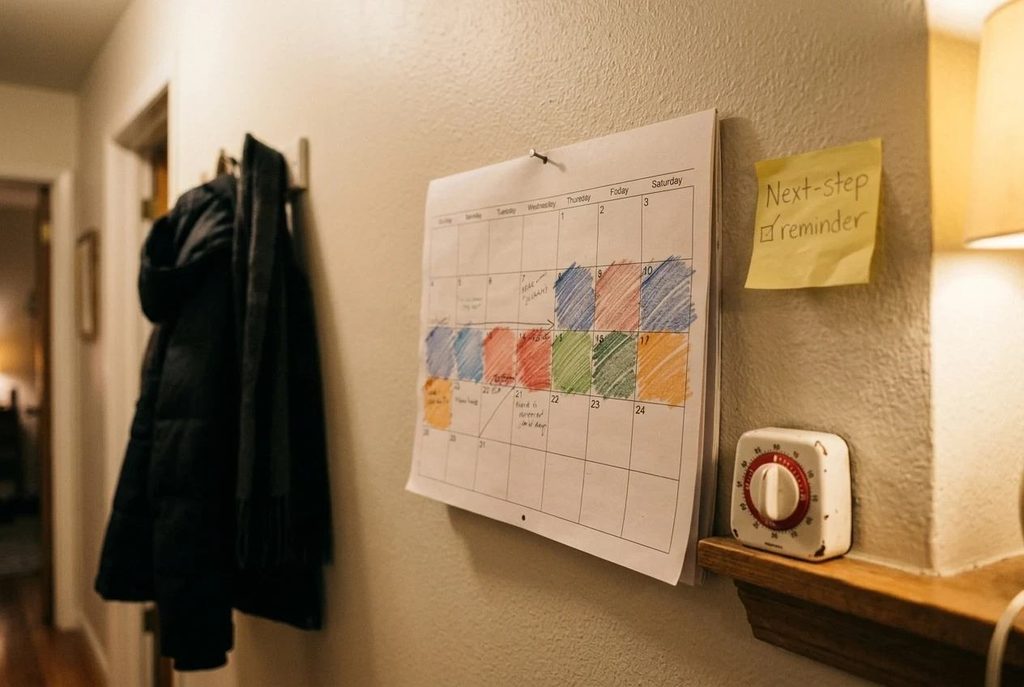
Pick the row that matches your audit, not the one you wish matched. Each version has the same core: a few short sessions during the week and one longer session when your energy is best.
If you have 5 hours
Three one-hour sessions on weekdays, plus one two-hour session on the weekend. Use the weekday sessions for smaller jobs like editing, research and replying to comments. Use the long session for the work that needs focus, like writing a full article.
If you have 3 hours
One 90-minute session on your best day, plus three 30-minute sessions during the week. The short sessions are for finishing and tidying. The long one is for making new things.
If you have 90 minutes
Three 30-minute sessions, or one 90-minute session if your week allows it. This is enough to make steady progress on a content site, slowly. It is not enough to run something that needs constant attention, which is another reason to choose your model with care.
Whichever version you use, decide the job for each session before you sit down. Ten minutes of “what should I do now?” is a big share of a 30-minute session. At the end of every session, write one line saying what you will do next time. That line saves you the warm-up the next time you sit down.
What to do first, and what to ignore until later
With limited hours, the order of tasks matters more than it does for someone with a free week. Here is a sensible sequence:
- Choose one model and one topic. Not three. Switching costs you hours you do not have.
- Learn the basics of how that model works. If you want the plain-language overview, my online business basics guide covers what you need and what you can skip.
- Set up one home base, usually a simple website.
- Publish something, even though it will not be perfect. Your tenth piece will be better than your first, but you only reach the tenth by finishing the first.
And here is what to ignore for now:
- A logo and brand colors.
- Several social media accounts. One at most, and only if your audience actually spends time there.
- Email automations and paid tools you do not yet have a use for.
- Another course, until you have used what you already have.
Buying the next tool or course feels like progress, and it is much easier than writing the next article. Be suspicious of that feeling, and be equally suspicious of anyone promising fast results from a small time commitment. My piece on online business scams lists the red flags I would check before paying for anything.
Protecting your job, your energy and your sanity while you build
Your job pays the bills while the business is not yet paying anything, so it comes first. Do not work on the business during paid hours or on your employer’s devices, and check whether your contract has rules about outside income.
Energy is the other limit. If every evening goes to the business, something else gets squeezed, usually sleep, and a tired person writes slowly and badly. Put one or two nights a week completely off the schedule, and treat those nights as fixed.
Tell the people you live with what you are doing and when. A sentence like “Tuesday and Thursday evenings, and Saturday morning, I am working on this” is easier on a household than a vague promise to be around more later. It also turns the time into something that can be planned around, instead of something that gets interrupted.
Finally, keep the stakes sensible. Do not put money you cannot afford to lose into a business that has not earned anything yet. Most of what a beginner needs costs little, and spending more does not speed up the slow parts.
The week it all falls apart, and how to pick it back up
At some point you will lose a week. A work crunch, a sick child, a parent who needs help, a house problem, or plain tiredness will take every free hour. This is normal and it does not mean you are not cut out for this.

What matters is what you do next. These steps help:
- Do not try to catch up. Missed hours are gone. Doubling next week’s schedule makes a second bad week more likely.
- Lower the bar to 15 minutes. A 15-minute session can be as small as editing one paragraph or reading your note from last time. The aim is to keep the habit alive, not to produce much.
- Start with the note you left yourself. This is why you write the next task at the end of every session. Restarting from a clear instruction is far easier than restarting from a blank page and a guilty feeling.
- Look at the schedule, not at yourself. If you lose several weeks in a row, the weekly rhythm may be too big. Move down a row, from five hours to three, or from three to 90 minutes. A smaller plan you keep beats a bigger one you drop.
I am still figuring out some of this online business business myself, and I have learned to treat a lost week as information about my schedule, not a verdict on my character.
Realistic expectations: how long this takes when you are part-time
Part-time work takes longer, and it is better to hear that now. Fewer hours means slower progress, and most online business models take months before they earn anything meaningful. For some it takes longer than that, and some never earn much. I cannot promise you an income figure or a date, and you should treat anyone who does with suspicion.
What you can control is consistency. A modest rhythm kept up over many months builds something real: a body of work, skills you did not have, and an audience that grows slowly. A burst of effort followed by silence builds very little.
Judge your progress by what you have done, not by what you have earned yet. Did you keep your sessions? Did you publish? Did you learn something you can use next time? Those are the measures you can influence in the early months, and they are the ones that lead to income later.
Your next step
You now have a number: the hours you really have. The next decision is which kind of online business fits that number. Read my guide to how to choose an online business model and keep your time audit beside you as you go, so you pick something that fits the hours you just counted.
